

How Delhi stopped a protest before it started
Troops, trains, the metro and the internet: how the government used everything it had to keep people away from one road in Delhi
In July, a 49-day protest at Jantar Mantar by the Cockroach Janata Party forced the resignation of Education Minister Dharmendra Pradhan. The move was seen as a rare setback for the Bharatiya Janata Party (BJP), which has been in power for 12 years and has a strong public image.
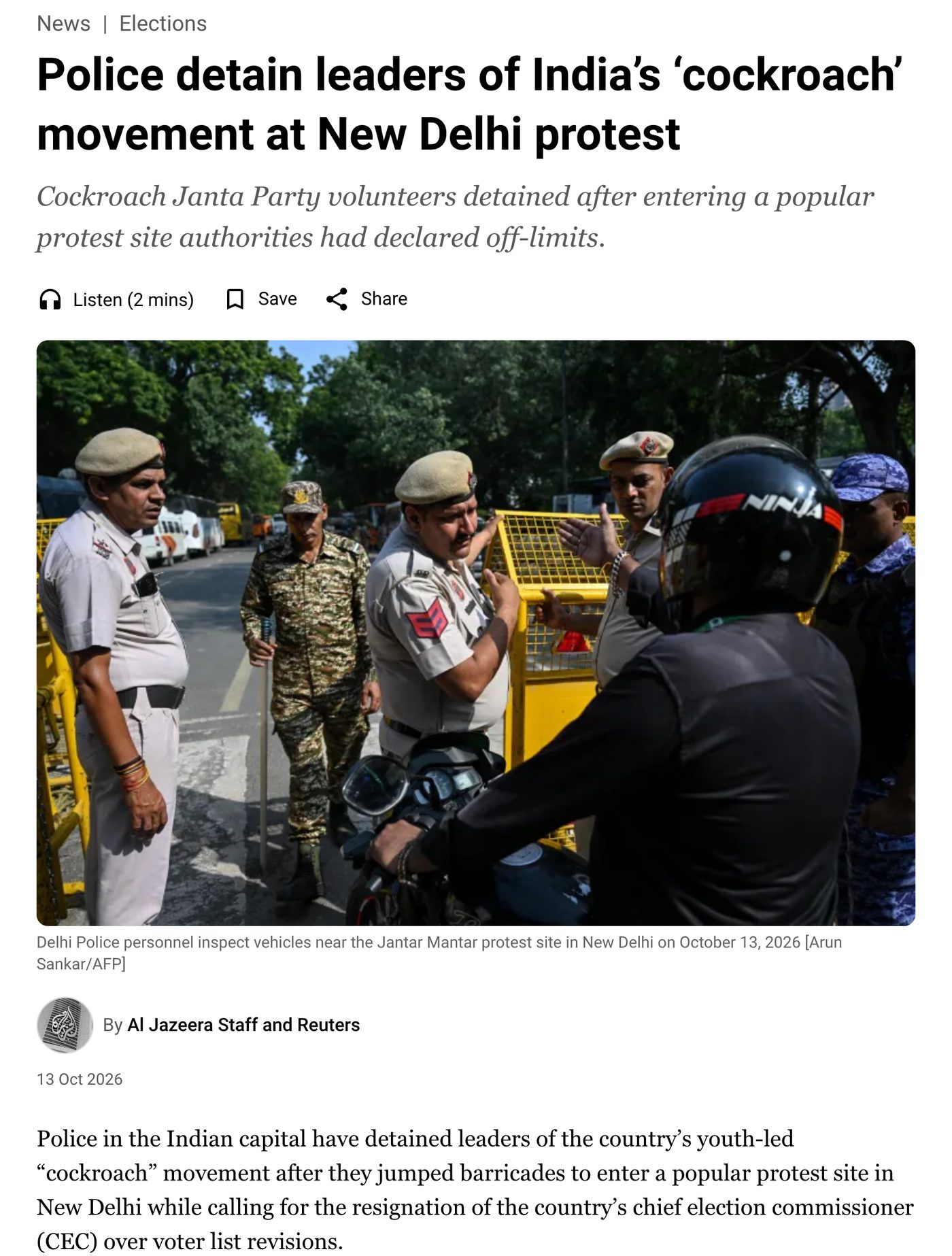
In response to growing protests across the country against the Special Intensive Revision (SIR) of voter rolls, the party organized a second rally called "Jantar Mantar 2.0." With ten days' notice this time, the government was able to mobilize all of its resources to prevent the event from happening.
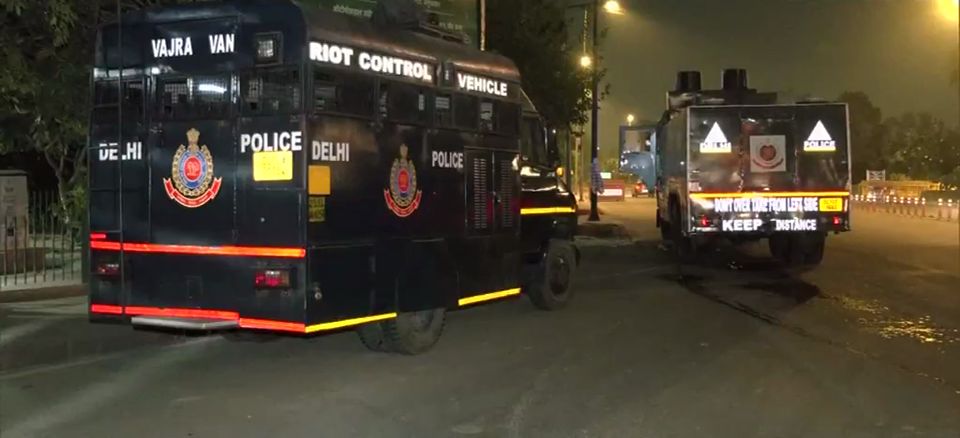
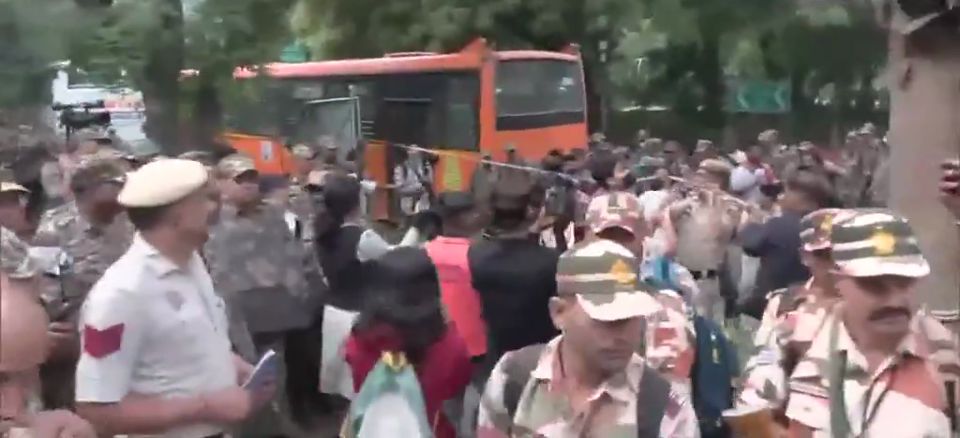
Four days before the protest, the Home Ministry authorized 221 companies of the central security forces, or roughly 23,000 personnel, to travel to Delhi. They added 80 additional companies two days later. The Home Secretary instructed police chiefs throughout the nation to prevent people from traveling to the capital, and the police ordered hotels in central Delhi to turn away visitors.
On October 10 and in the days before, this is how it developed and how far it extended.
- Thursday 8 October
-
The excise department shuts Delhi’s liquor shopsEvery liquor store in the city is to remain closed Friday and Saturday on what the order refers to as "inputs received from Delhi Police".
- Friday 9 October
-
Northern Railway cancels 45 long-distance trainsDue to "planned protest/demonstration," trains due into Delhi on Saturday morning are canceled at the stations they begin from, far-off as Howrah and Mumbai.
-
Northern Railway cancels 170 local trainsPassenger trains that run between Delhi and the surrounding towns, of which 170 are cancelled for Saturday while 9 more are stopped short of the city at Ghaziabad.
-
West Central Railway cancels 3 more trains, and blames trafficAnother part of the railways gives a different reason. "Three trains to New Delhi will remain cancelled to spare passengers inconvenience," reads the headline in Hindi, while the line beneath it states that the decision was "taken in view of traffic pressure."
Closing the railways is not a small event. On Friday, entire trains did not depart Howrah or Mumbai because the long-distance trains were cancelled at the stations where they originate. The majority of the cancellations, however, affected the locals and passenger trains that transport people from the surrounding towns to Delhi. Anyone who had intended to take the train had one day to find an alternative, or none, as the railway posted its announcements on October 9th, the day before.
The same Friday afternoon, the police letters made their way to the Supreme Court [WHAT DOES THIS MEAN?]
- Friday 9 October
-
The Supreme Court hears a challengeOn Friday afternoon, petitioners bring the police letters to the Supreme Court, which records the police's request that the Metro shut down the gates of 57 stations starting at 9 p.m.
-
The Supreme Court says the bans go too farThe government agrees to reexamine the orders, which the court claims amount to a total ban on essential public transportation; however, the Metro closes 45 of the 57 stations that evening.
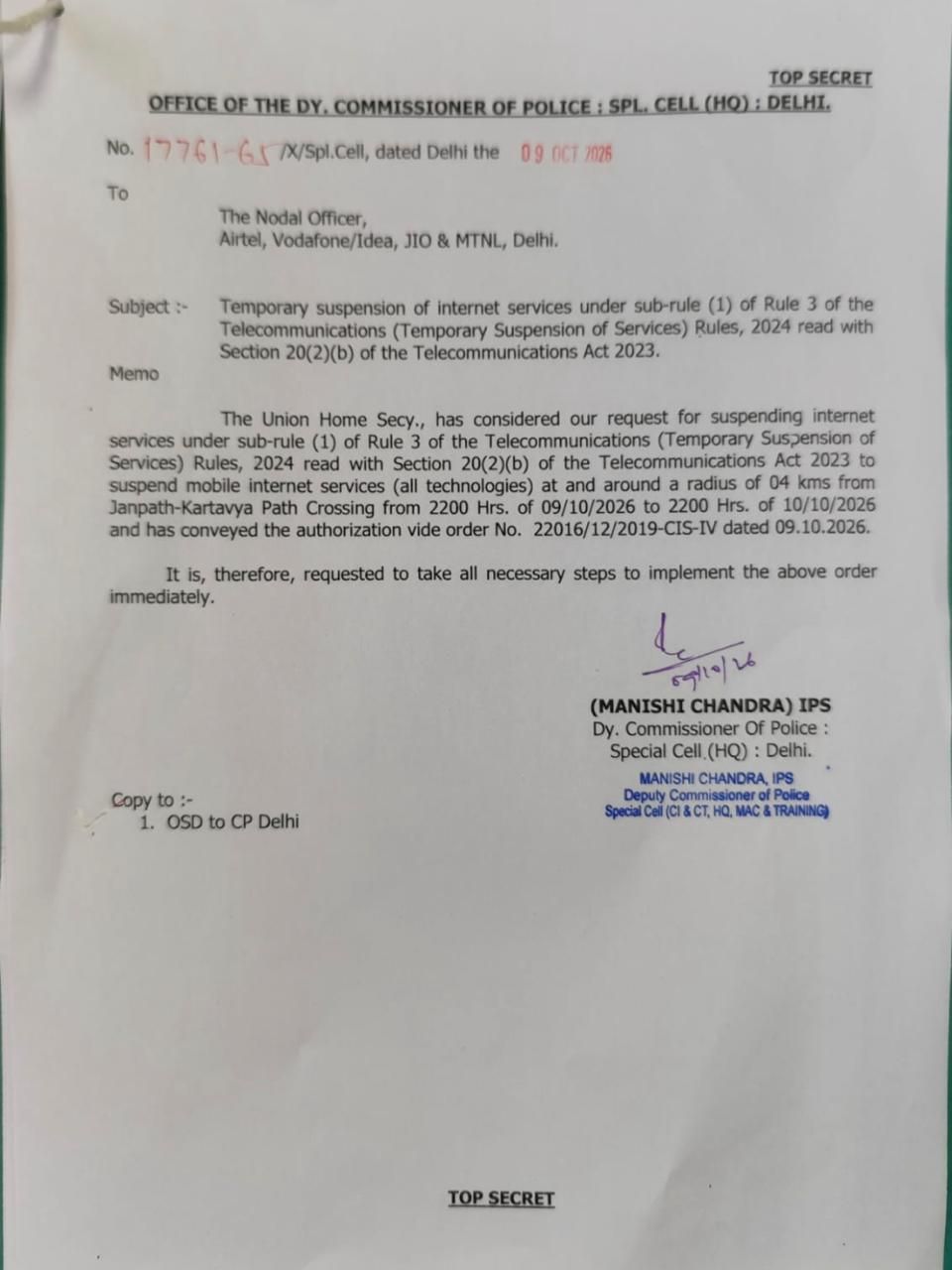
The Home Ministry also ordered the mobile internet shut. This was something it had done nine times in July and again on October 2 for the previous protests at Jantar Mantar, but never to this degree. In contrast to those orders, which covered 1.5 km around the site, this one covered 4 km, or roughly seven times the area.
- Friday 9 October
-
The Home Ministry cuts mobile internet in central DelhiStarting at 10 p.m. on Friday, mobile internet will be shut down for 24 hours in all locations within 4 km of the capital's center.
-
The Home Ministry cuts mobile internet at 8 more placesFrom noon to 10pm on Saturday, a second order cut mobile internet for 500m around 8 stadiums and community halls on the outskirts of the city,where people detained that day were held.
Neither of these orders was easily accessible to the public and only came to light when shared via a news agency [WHO?] at 6:56pm on Friday, a mere 3 hours before the internet was to be cut.
 12
1Marked "top secret"
2According to the Internet Freedom Foundation, roughly 50 square kilometers—which includes the Supreme Court, Parliament, and at least two major hospitals—were without internet access.
© OpenFreeMap, OpenMapTiles, OpenStreetMap
Inside Delhi, the orders found themselves extending up to 27 km from the protest site. A common pattern that has emerged with detentions at such protests involves protestors being picked up in buses and driven around the city, finally being dropped far from where they were picked up. In July, much of these detentions lasted a few hours. October 10, however, saw detentions late into the night and in some cases until the next morning. These protestors were held in stadiums and buildings on the edges of the city with no internet available. Social media videos also showed that some of these sites did not meet basic needs, like having clean water to drink.
Orders to shut, cut or ban reached 27km from Jantar Mantar, the protest site
Metro stations shut, mobile internet cut and gatherings banned in Delhi for Saturday 10 October
© OpenFreeMap, OpenMapTiles, OpenStreetMap
- 45 stations closed (~25 hrs)
- 12 left open
- 4 km radius for internet shutdown (24 hrs)
- 8 detention centres with internet shutdown (around 500m)
- Ban on public gatherings in effect
Source: Home Ministry orders of 9 October, Delhi Metro notices, Delhi Police letter to the Metro of 8 October, Delhi Police statement to the Supreme Court as reported by PTI. Police area boundaries from Geospatial Delhi
Limiting movement in the city is another way to keep people from getting to the protest. Shutting metro stations for a protest is not new; Delhi has done it since 2011, and most of the 45 metro stations shut down on October 10 have been shut before. What is new is how far out it went. Twenty were between 4 km and 10 km from the protest site, five were farther away than 10 km, and 12 had never been closed for a protest before. Some 45 are the stations that students use, such as Vishwa Vidyalaya, for Delhi University, and Jamia Millia Islamia.
On 10 October the Metro shut 12 stations it had never shut for a protest
Metro station shut on a day of protest between 2011 to 2026 ordered by distance from the Jantar Mantar protest site
A grid of the 56 metro stations the police asked Delhi Metro to shut on 8 October 2026 against the 59 days since 2011 on which Delhi Metro shut gates for a protest.
2026 anti-CEC protests
10 October 2026
45 stations shut
© OpenFreeMap, OpenMapTiles, OpenStreetMap
56 police-requested closures
- Closed Oct. 10
- 45
- Remained open
- 11
- No prior protest closures
- 12
- Protest closure days since 2011
- 59
Within 4km of Jantar Mantar
4km to 10km away
More than 10km away
The same few stations around Parliament have been closed every time since December 2019. For the protests against the citizenship law, the stations were closed all the way in Jamia, which is across the river that divides the city. For the protests by farmers, they were closed around to the north of the city. On October 10, these shut downs happened everywhere.
Since 2011, 414 stations have been closed, 137 of which were brought on by protests at Jantar Mantar in 2026.
Since 2011, one-third of all metro closures due to protests have happened in 2026
Yearly count of times a Delhi Metro station was closed for a protest.
Source: Delhi Metro notices as quoted in news reports
Despite all of this there was scattered coordination on the ground, from Thursday to Sunday. The protest was called for Saturday, and not only by CJP. Left parties, student leaders and opposition leaders all gathered around Delhi, were determined to show up and attempt trying to get to the site.
This was handled, as quoted by the Supreme Court, in the manner of “a hammer to swat a fly.” More than 20,000 police and central forces were spread across the city, so a protest that cropped up anywhere was put down within 20 or 30 minutes. Getting to the protest site became a sign in and of itself, which led to protests happening in different parts of the city, with people working together as best they could.
Thursday 8 October
Friday 9 October
Saturday 10 October
Sunday 11 October
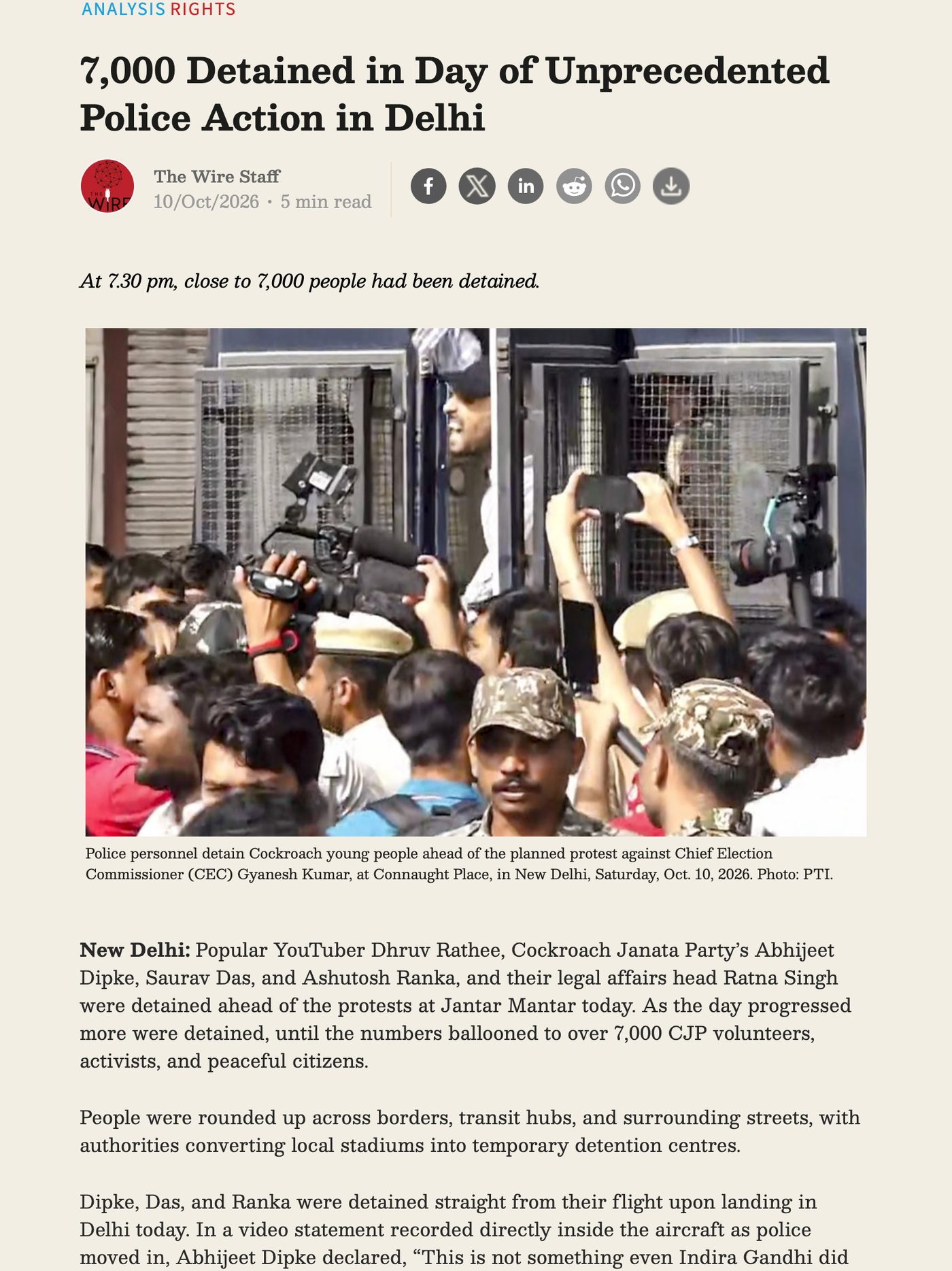
The closures were supposed to separate people, complicate communication once you were inside the area without internet, and disrupt the momentum of the protest. There were arrests in cities far away, hostels and houses were raided to find potential protestors and prevent them from joining the demonstrations, journalists and prominent people such as Youtuber Dhruv Rathee were held at home, and anyone who managed to assemble at all was carried off to holding centres across the city.
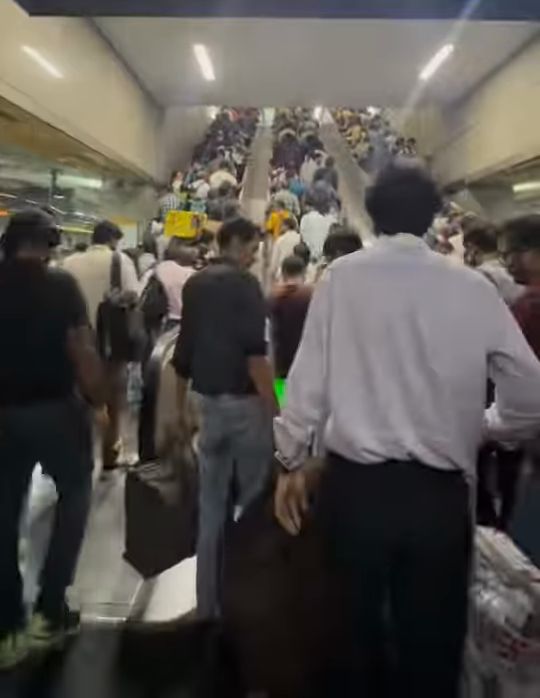
On that day, though, if you had to work around the area, even if you had completely no interest in protesting, there was not much you could do about it. One in every seven metro stations was closed; while the Delhi Metro records a normal Saturday ridership of almost 58 lakh, on October 10 the count dropped to almost 32 lakh.
Delhi Metro lost nearly half of its passengers and shut one in seven stations on October 10
Trips taken on Saturday, October 10th, compared to the Saturday before
15 in 100 stations closed
46 in 100 trips cancelled
Source: Delhi Metro, as reported by the Patriot. 45 of 303 stations were shut. 32.1 lakh journeys were made on 10 October and 59.4 lakh on 3 October. 1 lakh is 100,000
Earlier, shutting down one metro station still meant you could get off at the nearest next one and walk or take an auto to the site. For instance, while the metro station nearest to the protest site, Janpath, was shut on October 2, you could still get off at Shivaji Stadium which was a 14-minute walk away. The airport-only line metro station was the closest on October 10, and it took about 30 minutes to walk there. Chandni Chowk, the nearest regular station, was almost an hour away on foot.
The nearest open metro station to most of the city on October 10 was an hour by walk from Jantar Mantar
Walking time from Jantar Mantar to the nearest open station: normal day vs. Oct. 2 and Oct. 10
© OpenFreeMap, OpenMapTiles, OpenStreetMap
Source: Delhi Metro notices. Walking routes calculated with openrouteservice on OpenStreetMap
Beyond those attempting to reach the demonstration, the widespread shutdowns inconvenienced general transit users, depriving people living in nearly 57 km2 of access to a metro station within a 15-minute walk.
From 14 of the 45 shut stations, the nearest open station was at least a 30-minute walk away
Walking routes from each station that closed on October 10 to the closest station that remained open
© OpenFreeMap, OpenMapTiles, OpenStreetMap
- Area normally within a 15-minute walk of a station
- Walk from a shut station to the nearest open station
Indraprastha
51 minutes to Laxmi Nagar, 4.3km
14 stations, 30 minutes or more
10 stations, 20 to 29 minutes
20 stations, 10 to 19 minutes
1 station, under 10 minutes
Source: Delhi Metro notices. Walking routes calculated with openrouteservice on OpenStreetMap
For the 229 train cancellations, rail officials gave mixed messages. They said that 218 were due to planned protests, 62 were due to expected traffic jams, and 52 trains were listed in both lists. Due to the cancellations, long-distance services between cities like Mumbai, Kolkata, Patna, Lucknow, and Katra were stopped.
Cancelled train routes on October 10
- 166 trains cancelled for a “planned protest/demonstration”
- 62 trains cancelled for “anticipated severe road traffic congestion”
© OpenFreeMap, OpenMapTiles, OpenStreetMap
172 local trains cancelled around Delhi
© OpenFreeMap, OpenMapTiles, OpenStreetMap
Source: Northern Railway and West Central Railway press releases, 9 to 11 October. Distances are measured along the track. 13 of the 229 cancelled trains are not drawn because their route is not known. 11 more trains were cut short or run late
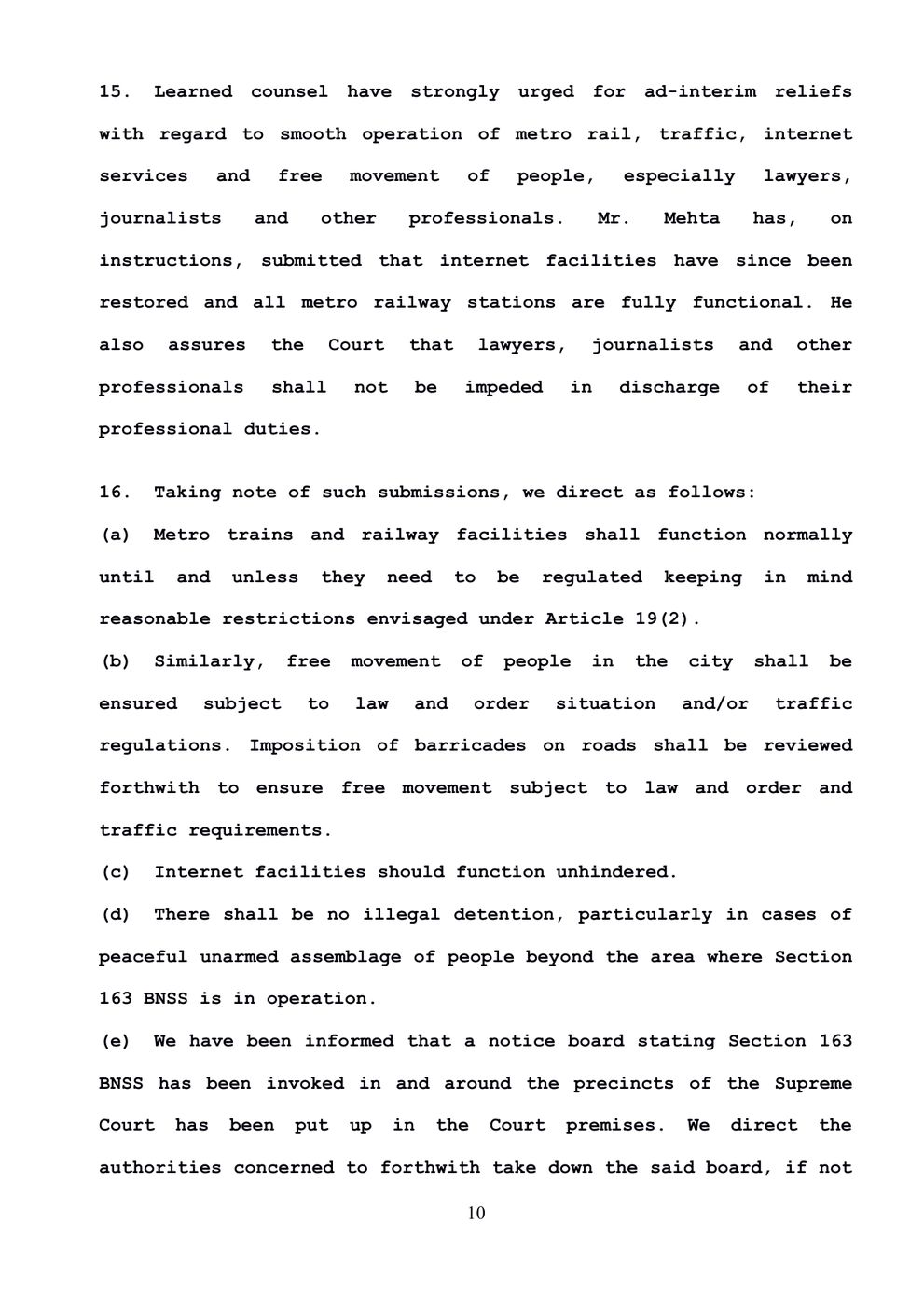
Convening on a Sunday, the Supreme Court issued a series of directives and the bench ruled that both the Metro and national railways "shall function normally," mandated that internet services remain unhindered, and explicitly prohibited unlawful detentions, focusing "particularly in cases of peaceful unarmed assemblage of people."
 12
1Even so, Delhi Metro shut 6 stations again on Monday morning, from 6am to 5pm.
2Within 3 hours of this order, police had put at least 6 journalists in a van.
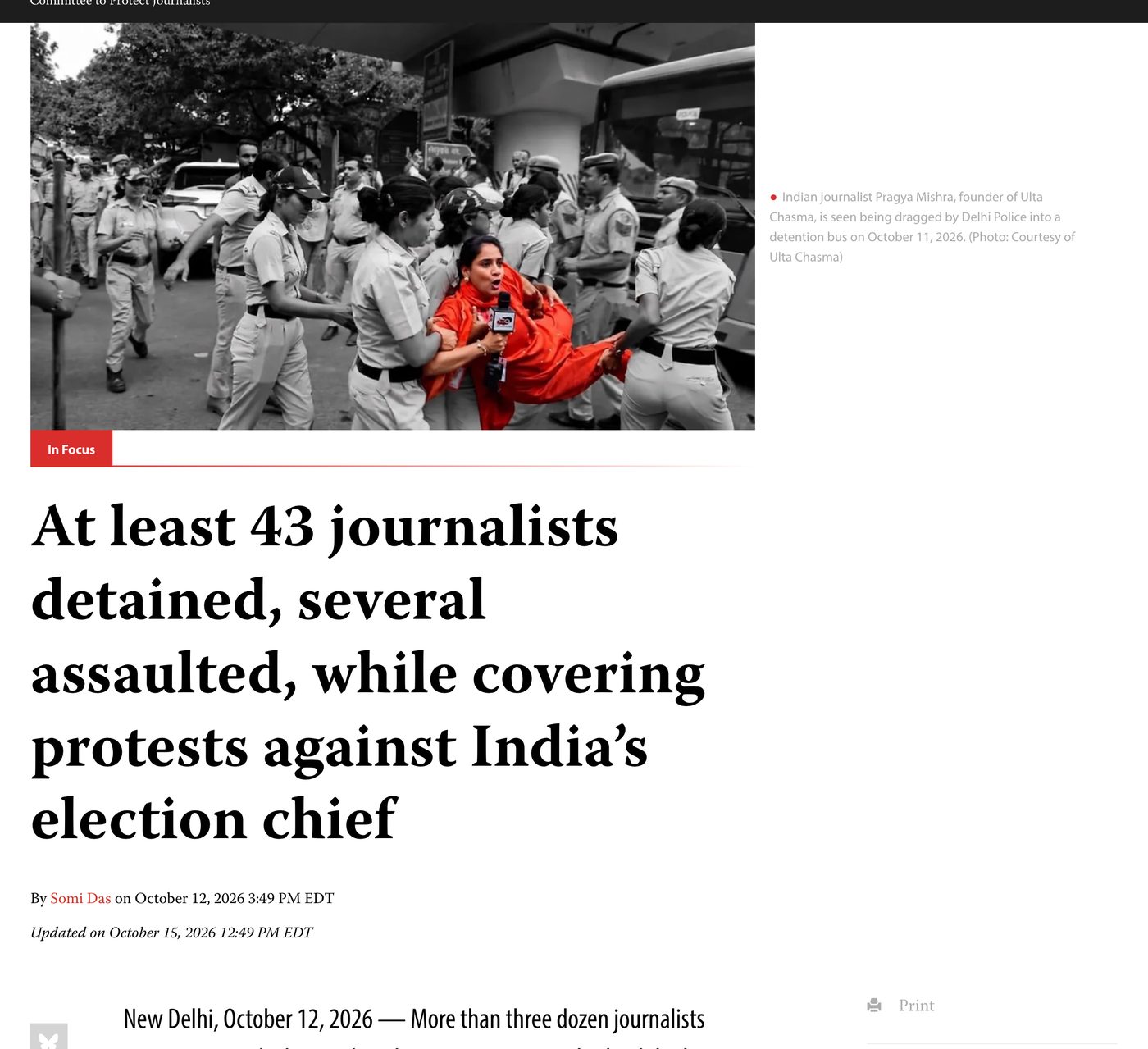
Security forces ignored the court rulings, detaining at least 43 journalists over the next two days.
Detainees were loaded onto buses, driven around the capital, and released at locations as far as 25 kilometers from where they were picked up. Police confiscated cameras and cell phones, and one reporter claimed to have been assaulted for refusing to remove the video, all of which rights activists describe as attempts to prevent the media from covering future protests.
The protest site itself was also canceled at the same time. An official order made public on Monday showed that the police commissioner had taken away the right to hold protests at Jantar Mantar, which had been a place for such displays for more than 30 years. Demonstrations have been moved to new places, such as Ramlila Maidan, the northern Burari ground, and the eastern CBD ground, which are much farther from the city center.
This is the most recent step in a decades-long effort by the government to move protests away from government buildings. "First they took away India Gate, then they took away Boat House, and now they have taken away Jantar Mantar," one protester said during the week's events, referring to moves that happened in the 1990s.
- Monday 12 October
-
Traffic police warn that roads may close againTwo days after the protest, the traffic police list the junctions in central Delhi where roads may be closed again.
- Tuesday 3 November
-
The Supreme Court takes back one of its directionsThree weeks later the Court withdraws one of the directions it gave on Sunday 11 October, and adds that it never suspended the ban on gatherings.
On 16 October, a week after the protest, CJP tried to protest again. Its founders were detained and driven to Jaffarpur Kalan, the police station on the western edge of the city where a former chief minister had been taken six days earlier.
The central forces approved for five days are still in Delhi. TK TK TK TK END SOMETHING OR THE OTHER
TK TK TK TK END SOMETHING OR THE OTHER
TK TK TK TK END SOMETHING OR THE OTHER
TK TK TK TK END SOMETHING OR THE OTHER
TK TK TK TK END SOMETHING OR THE OTHER
TK TK TK TK END SOMETHING OR THE OTHER
TK TK TK TK END SOMETHING OR THE OTHER
How this was made
- The information in this story comes from 200 records gathered from 179 public sources between October 10 and November 10, 2026. You can download both of the lists below.
- The Home Ministry, the Supreme Court, the Delhi excise department, the Northern Railway, and the West Central Railway issued the orders displayed, while the Internet Freedom Foundation published the police letter on the internet shutdown. The second internet order names 8 grounds, and it was the Hindu that reported people were held at them.
- Using news sources quoting Delhi Metro's notices, we compiled every day since 2011 on which Delhi Metro closed stations for a protest to compare 10 October with past demonstrations. After excluding closures for state visits, the G20, and security warnings, that gives 59 days. Ridership on the day comes from Delhi Metro’s affidavit to the Supreme Court, as reported by LiveLaw, and from daily figures reported by the Patriot.
- The shortest walking distance between two stations at a speed of five kilometers per hour is determined using OpenRouteService, and the same method determines the area that is within a 15-minute walk of each of the 279 metro stations in and around Delhi. Every distance is a minimum since the shortest path by road separates someone who was arrested in one place from another.
- The Northern Railway and West Central Railway press releases from October 9–11 list the 229 cancelled trains. Each is drawn along the railway track in OpenStreetMap, with its distance measured along that route.
- The area where gatherings were banned follows the police sub-divisions that Delhi Police listed in its affidavit of 3 November, as reported by PTI, drawn on boundaries from Geospatial Delhi.
- The journalists named are those listed by the Committee to Protect Journalists. For the number of people detained overall, police said about 500 by mid-morning and 2,500 by night, while PTI, citing police sources, reported more than 7,000.
- Maps use data © OpenStreetMap contributors and are drawn with Protomaps, with India’s boundaries from DataMeet (CC BY 4.0).